Charles Ibbotson 1813 – 1883

I have produced the following research as Charles Ibbotson (1813–1883) was the first known descendant of Edward (1641–1702) of Hathersage, Derbyshire to emigrate to Australia. He was a brother of my great-great-grandfather John Ibbotson (1816–1876).

Derbyshire, England

Charles was born at Spray House Farm, Little Hayfield, Derbyshire, England in 1813 to Samuel Ibbotson (1784–1873) and Martha née Hyde (1787–1862) of nearby Mellor. They had married at Manchester Cathedral in 1810. Martha was from a prominent Mellor family.

Samuel’s father, John Ibbotson (1755–1841), had moved his family from their ancestral home village of Hathersage to Little Hayfield around 1798.

The first five of Samuel’s children, including Charles, were baptised at St Matthew’s Church of England in Hayfield, from Spray House Farm, Little Hayfield.

Samuel Ibbotson remained sheep farming at Spray House Farm until about 1825, when he moved the family to the Ashopton Inn in the Derwent Valley where he became innkeeper. Charles was around 12 years old at the time. Charles’ youngest sibling, Harry, was baptised from the Ashopton Inn in September 1825.

The villages of Ashopton and Derwent, including the inn, disappeared in the 1940s to make way for the construction of the Ladybower Reservoir.

It is not known how long Samuel and his family remained at Ashopton. Sometime after 1826, the family moved to the hamlet of Nether Handley. In August 1833, a newspaper article reported the accidental death of a boy of about 10 years. The boy was the “son of Ibbotson” of Handley, clearly young Harry.

Emigration to the colony of New South Wales

It appears that Charles left the family in 1831, aged about 18 years, prior to young Harry’s death, and emigrated to the colony of New South Wales, Australia. His actual emigration or immigration is not listed in official records in Australia, nor are the circumstances leading up to his emigration known.

However, another England-based descendant of the Hathersage Ibbotson clan provided the author with an old family artist’s drawing of a young Charles Ibbotson, with handwritten notations on the reverse suggesting that Charles “sailed” on the ship Margaret on 8 July 1831, with mention of Messrs Bryant Bros, Sydney.

A search of New South Wales shipping records shows the “Margaret” departing London and Portsmouth in July 1831 arriving in Sydney harbour after a 19 week journey on 2 December 1831.  The ship was carrying the new Colonial Governor Richard Bourke and his family and official entourage. They were Cabin passengers however the names of those ‘lesser’ steerage passengers, described in a newspaper article at the time as “and about 40 persons, servants and others”, were not listed.  If in fact Charles was on that ship he must have been one of those ‘others.’

Messrs Bryant Brothers

With respect to the mention of Messrs Bryant Bros, open source and newspaper archives confirm that Messrs Bryant Brothers were at the time a London based merchant company and shipping agent trading in wool and general merchandise, with interests in Sydney, Australia.

In June 1834, a notice appeared in the Sydney Gazette newspaper advising that Bryant Brothers from London were opening a store in Sydney.  The store was located in George Street near Sydney Harbour.  Further advertisements advised that Messrs Bryant Brothers of London had been connected with Sydney for some years and announced that S A Bryant, later identified as one of the brothers, Stephenson Atkin Bryant, had arrived to open an agency (of the firm) in Sydney.

What role Charles Ibbotson played, if any, in the affairs of Messrs Bryant Brothers between his purported arrival in Sydney in December 1831 and the despatch of one of the Bryant Brothers 2 ½ years later to open a Sydney agency is not known. It seems however that given the notes on the reverse of his portrait that his emigration was somehow connected with the firm.

Birth of children

By 1834/35, Charles has made the acquaintance of Irish born Mary Ann (Dickens)1812-1882 (her surname was not revealed in public records until their eventual marriage in 1850 when it was given as Dickens.)   Their first child was born in Sydney in 1835 with three more following in 1839, 1844 & 1846 – see below for their stories.  Charles & Mary Ann had not married, or at least no marriage had been registered.  The first three children’s births were registered with parents as Charles Ibbotson & Mary Ann.  The fourth child was not registered.

Nothing is known of Mary Ann’s background apart from in the 1861 UK Census (the family was visiting London at the time) where she gave her place of birth as Cork, Ireland.

Charles is first mentioned in Sydney newspapers in August 1842 and again in January 1843 where a Mr Ibbotson is mentioned as a contact person for S A Bryant and Co. King Street, Sydney.  In August 1843 Mr Ibbotson is referred to as a Clerk for Mr Bryant. 

By August 1846, S A Bryant is effectively insolvent with Charles as one of the creditors being owed £256.  Litigation in various forms continued until March 1850.  Other creditors wanted to settle for a small percentage of what was owed to them on a promise by Bryant that they would eventually be paid in  full.  Charles was the only creditor opposed to the release of Bryant from his bankruptcy.  He wanted to be paid in full, at one point alleging that Bryant had hidden away assets or otherwise behaved fraudulently (see below for apparent confirmation, some 25 years later, of Bryant’s character.)  The outcome of the litigation is not clear however it seems that Bryant was released from his insolvency with Charles seizing on warrant some of Bryant’s furniture. There had clearly been an acrimonious falling out between Charles and Stephenson Bryant.

Marriage

Soon after the aforementioned litigation ended, Charles finally married Mary Ann on 12 June 1850 at St Lawrence C of E, George Street, Sydney.  St Lawrence was an Anglo-Catholic church. Her maiden name of Dickens was first revealed in the formal marriage registration. Apparently, this church had an emphasis on early Catholic teachings. Charles had been raised as C of E.  Mary was likely an Irish Catholic.

Relocation to Geelong, Victoria

After 19 years in Sydney where he had clearly gained considerable mercantile experience, and soon after their marriage and litigation with employer Stephenson Bryant ended, apparently not in Charles’ favour,  Charles and family have sailed from Sydney to Port Phillip (Melbourne.)  A newspaper reports that on 12 September 1850, Mr Ibbotson and family sailed on the ship Prince of Wales for Melbourne.

Dalgety Ibbotson and Co.

In 1834, Frederick Gonnerman Dalgety 1817-1896, aged 16-17 sailed from London to Sydney, New South Wales and, similarly to Charles Ibbotson, began working as a Clerk for other merchants/traders. In I842 he moved to Melbourne and by 1848 was a successful Merchant/trader in his own right, trading as Dalgety Gore & Company.

By 1850, Dalgety Gore and Co. had an office in Geelong and employed Charles.  Charles was first mentioned in Geelong newspaper articles in February 1851 when a cheque drawn by Charles on the account of Dalgety Gore and Co. was lost on the street in Geelong.

Dalgety returned to London in 1854 after earlier having made Charles a partner in his company and leaving Charles to manage the Geelong business.  The other partner, Harry Gore, had retired.  The new partnership was formalised as Dalgety Ibbotson and Co.  The company continued primarily it seems on the back of the Ballarat Gold rush and the wool trade and was extremely profitable. Their many sheep ‘runs’, mostly crown leases throughout Victoria, produced wool that was housed in their Geelong wool stores on the corner of Moorabool and Brougham Streets before being exported to England.

(Around this time, Charles’ former Sydney employer, Stephenson Atkin Bryant, surfaces in Williamstown, Melbourne again as an insolvent Merchant.  He then moves to Geelong around 1860 and in the years leading up to his death in 1873 he was, ironically, a Magistrate and clerk for the local Sheriff and Lands Officer responsible, inter alia, for the collection of fees related to usages of Crown Lands in the district.  After his death it was discovered that, apparently unbeknown to more senior authorities at the Victorian Lands Department, he was again/still insolvent with many unpaid debts.  It was then found that in connnection to his roles as under-sheriff and Lands Officer he had been effectively embezzling government funds over many years.)

Charles had become quite prosperous in a relatively short time, presumably through his company shareholdings.  He had acquired land in his own right in Newtown, Geelong and in 1854, the same year that he assumed full management of the company, had a large house prefabricated in Germany and later assembled on the land he had acquired at Newtown.  He named the property ‘The Heights.’  The house remained with the family for three generations until it was bequeathed to the National Trust in 1975.

Meanwhile, he and Mary Ann had two more daughters born at Newtown in 1852 and 1854 respectively – see below for their stories.  Neither birth was formally registered.

Over the next 25 years or so, Charles became a prominent member of the Geelong community. He held a number of directorships, was  a Magistrate for the City of Geelong, councillor and Mayor for the Borough of Newtown and Chilwell and Chair of the Chamber of Commerce.  He was also a patron of the Botanical Gardens in East Geelong, importing a number of seedlings that produced some of the plant varieties still evident today.

Charles was becoming increasingly wealthy. His name, either independently or in conjunction with Dalgety entities is officially linked to many pastoral runs throughout Victoria and New Zealand between the 1850s and early 1880s.  Those that he acquired in his own right including Tawanga Station, Spray House Farm, Hermsley Farm and Pack’s Farm were gifted to two of his daughters shortly before his death – see below.

Tawanga Station

One of the squatter runs taken up by Charles was known as Tawanga (now Tawonga) in the high country of the Kiewa Valley near Mt Beauty, Victoria.

Charles’ younger brother, Thomas Ibbotson 1821-1858, emigrated to Australia in 1851. It is not known whether he landed in Sydney or Melbourne as his immigration record cannot be found.  He appeared in the March 1851 UK Census as still resident with his father Samuel, mother Martha  and other siblings, in the village of Nether Handley, Parish of Staveley, Derbyshire.

Thomas next surfaces 3 months later on 24 June 1851 in the Lands Department for the State of Victoria register as the official occupier of the pastoral run Tawanga in the Kiewa Valley, Victoria.  He must have departed England soon after the 1851 Census.

His brother Charles was clearly behind taking up this squatter ‘run’ and presumably behind Thomas’ emigration to manage the property.  Interestingly, the Tawanga pastoral run was primarily cattle country whereas Charles and Dalgety’s interests were primarily sheep farming, servicing of other squatter/settler needs and related wool broking concerns.

Charles himself assumed formal control of Tawanga, at least on paper, in 1855. A police report at the time lodged by a manager of the property, Marcus Hobbs, reports the theft of a valuable bull carrying Charles’ brand C.I.

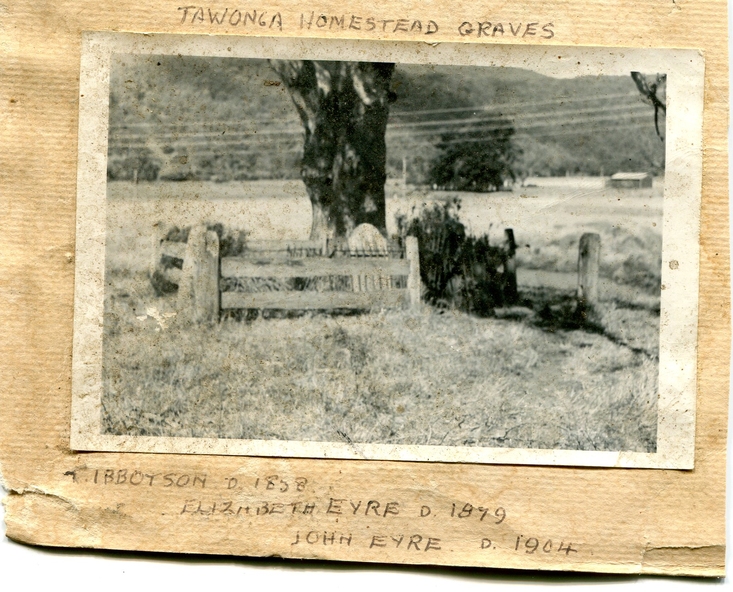
Thomas died in 1858 aged 37 years on the property after a lightning strike spooked his horse and threw him into a tree.  Thomas’ death certificate gives his place of death as ‘Little River’ which was the name the Kiewa River was known by at the time. His parents were given as Samuel & Martha.  The informant was given as Charles Ibbotson. He was buried on the Tawanga property.

A John Eyre (1826–1910) and his wife Elizabeth Eyre née Hollands are also buried on the property with Thomas. John, along with Charles and Thomas, was born at Hayfield, Derbyshire and emigrated to Australia in 1848 aged 22, prior to Thomas. His immigration record nominates his nearest relative as his cousin Charles Ibbotson of Sydney.

John’s mother was Mary Eyre née Ibbotson, a sister of Charles and Thomas’ father, Samuel. Mary had married George Eyre, a prominent wool manufacturer at Hayfield.

Charles Ibbotson death

After Charles’ health began to decline in 1882, his son Alfred Charles Ibbotson (1844–1926) assumed oversight of the Tawanga Station property, along with his father’s other extensive business and property interests (Charles’ eldest son had been in New Zealand since 1864).

Apparently accepting his imminent demise, Charles, with son Alfred, began arranging his affairs. He appears to have gifted ownership of Tawanga and three other freehold properties to daughter Fanny, and the family home ‘The Heights’ to daughter Minna – see below. A further 320-acre property near Portarlington went to his nephew (my great-grandfather), Harry Marsland Ibbotson – see his story at Ibbotson Emigration to Australia.

Charles died at Newtown, Geelong on 20 October 1883 aged 70 years. His wife Maryanne had died the previous year aged 69 after “many years of suffering.” He left a personal estate of £89,500, largely consisting of various shareholdings including Dalgety Ibbotson & Co. The estate was to be shared between Alfred and his siblings.

As mentioned above, his substantial property assets had been distributed to his two then-spinster daughters.

Charles and Maryanne are buried at Geelong Western Cemetery.

Charles’ son became sole executor of Charles’ estate. It has recently come to light, through other extended relatives in England, that some of Charles’ English close relatives, including at least one niece, were potential beneficiaries of a trust managed by Charles’ son Alfred. 

In 1884, London based Dalgety was converted into a joint-stock company with Dalgety principal Frederick Dalgety as managing director until his death in London in 1894. 

Around this time, Alfred and his family left Geelong and emigrated to England.  In May 1901, all the remaining Dalgety partners, including by this time Alfred, met in London and formally dissolved the various partnerships, including those relating to their interests in Victoria and New Zealand. 

Apart from eldest daughter Ada (see next below,) the only remaining Ibbotsons connected to Charles, through his brother John, to continue in Victoria were John’s two sons (Charles’ nephews) Harry Marsland Ibbotson who died at Portarlington in 1939 and Charles who died at Macedon in 1904 along with daughter Mary Ann Peet nee Ibbotson who died in 1931 also at Macedon – see above Ibbotson Family History for further. 

Charles and Maryanne had six children in 19 years:- 

Adelaide (Ada) Augusta 1835-1912
Frank William 1839-1908
Alfred Charles 1844-1926
Fanny Matilda 1846-1919
Lilias Mary 1852-1900
Minna Elizabeth 1854-1938 

Adelaide ‘Ada’ Augusta 1835-1912

Ada was born in Sydney, NSW in 1835. On 2 Feb 1869 she married the Baron Frederic Guillame de Pury 1831-1890. Frederic was born in Neuchatel, Switzerland to Swiss aristocracy and after first emigrating to England to study the English language, emigrated to Victoria where in 1863 he established a vineyard/winemaking industry which he named Yeringberg in the Yarra Valley near Melbourne. He and Ada had two sons, George Alphonse de Pury 1870-1956 and Victor Edward Montague de Pury 1873-1960. He and Ada travelled back to Switzerland on a number of occasions. Frederic died unexpectedly on one of those visits in Lausanne in 1890 aged 58 years.  Interestingly, Ada’s sister Lilias also died in Lausanne, Switzerland aged 48 years in 1900 (reported in the Melbourne Age newspaper) presumably while visiting Ada on one of her visits and notwithstanding that Frederic’s death occurred there 10 years previously.  Ada died at Yeringberg in 1912 aged 76 years. She is buried at Lilydale cemetery.   Descendants of Ada and Frederic are still in the wine industry in the Yarra Valley to this day (2025) having resurrected same in the late 1960s.

Frank William 1839-1908

Frank, the first of two sons, was born in Sydney, NSW and grew up initially in Sydney and Geelong.  At some point in his 20s he emigrated from Geelong to Otago Province, New Zealand presumably at the behest of his father. His death certificate suggests that he had been in NZ since 1865. In 1884 he married Marion Hamilton 1865-1952 at Dunedin when he was about 45 years of age and she was 19 although he declared his age at the time as 38!

Frank declared his occupation as ‘runholder.’  At some point after emigrating, he had taken up a pastoral run known as Otama Station near Gore, north of Invercargill.   The estate consisted of three stations totalling about 81,000 acres, Otama, Waikaka and Mount Wendon however for all intents and purposes they were run as one from Otama where Frank based himself.  A newspaper article in the Southland Times of 25 May 1887 gives a glowing and detailed report on Otama Station.

His father Charles, at least on paper, also had sheep runs in the Mount Wendon area at the time presumably on behalf of Dalgety & Co.

A further open source newspaper article 4 years later in 1891 reports on a court case where a ‘friend’ of Frank attempted to prevent Dunedin and other local hotels from supplying liquor to him on the basis that his apparent drinking was inter alia destroying his health and his estates.  The action failed however the magistrate commented that this may cause Frank “who was well respected to turn over a new leaf.”

Frank retired to Dunedin in the late 1880s either selling, relinquishing or losing his various pastoral leases. He died in 1908 aged 69 and is buried at Anderson Cemetery.  Marion died in 1952 aged 87 years. Frank died without a will. His wife was granted probate however his liabilities exceeded his assets. He owed small amounts of money to local traders & Dalgety & Co.  His brother Alfred was involved in sorting out his affairs.

Frank’s younger cousins, (our ancestor John’s sons) Thomas Hyde Ibbotson 1859-1910 and William Ibbotson 1864-1918 both emigrated and joined Frank on the sheep stations after their father had died in England. Thomas must have arrived earlier as he is missing from the 1881 English Census whereas William is still there with his mother aged about 16 years – see separate Ibbotson Family History for further.

This was about 5 years after Charles brought his nephew, Harry Marsland Ibbotson, to Victoria, Australia (1876) to initially work on his uncle Charles’ Spray Farm at Bellarine and later to take up what became known as ‘Enfield’, a 320 acre property on the Portarlington Queenscliff road.

According to another family history Thomas & William were initially employed as rabbit shooters (rabbits and wild dogs were a huge problem during these years.) Official records in the latter 1880s show that Thomas went on to own/operate a gold mining dredge on a river near or on the farm at Waikaka Station while resident nearby on the Otama property.  He married Emily Ross 1864-1944 in 1884 and died in 1910 aged 51 years from pneumonia after having sold his dredging interests.  Emily died at Invercargill in 1944 aged 80 years. Their son, Charles Robert Ibbotson 1893-1916 was killed in action in France during WW1.  Another son William Ibbotson 1898-1975 followed Charles (after his death) to France but was repatriated back to New Zealand in 1918 with acute pneumonia (this was at the time the so-called Spanish Flu pandemic was sweeping the world with returning WW1 soldiers unwittingly contributing to the spread.)

William’s occupation is given on electoral rolls as farmer on Thomas’ neighbouring Waikaka station. He married Agnes Jones in 1891.  He remained on the farm until sometime prior to 1912 when he had moved with his wife to the North Island as the licensee firstly of the Windsor Castle hotel in Auckland and then the Putaruru Hotel (near Hamilton.) He died in 1918 aged 54 years from pneumonia during the influenza epidemic. He is buried at Haupatu Cemetery, Waikato. Agnes took over as licensee of the Putaruru hotel.  Agnes is found on electoral rolls in the area into the 1930s however her death is not recorded.  They had six daughters but no sons.

Alfred Charles 1844-1926

See here for Alfred’s story.

Back in Geelong

Fanny Matilda 1846-1919

Charles Ibbotson’s 2nd daughter Fanny was born in Sydney, NSW. Neither Fanny nor her younger sister Minna had married during their parent’s lifetime.  Her father gifted Spray Farm, Bellarine to her in 1882, the year before his death, along with Hermsley at Curlewis and another which is now part of Clifton Springs near Drysdale. It seems that she must also have received the property at Tawanga (320 acres) as all four properties are contained in her Will of 1888. 

Fanny married Spray Farm groomsman John Clee 1860-1923 in 1887 at age 41 when he was 27. They continued to live there for the rest of their lives.  Her father had bought Spray Farm in 1865 from J C Langdon, one of the Bellarine Peninsula’s original squatter families. Charles changed the name of the farm from ‘Ellendale’ to Spray House Farm after the farm of the same name as his birth place in Little Hayfield, Derbyshire. When Fanny died childless aged 73, the farm passed to her husband John Clee who died 4 years later in 1923 aged 63. The properties were ultimately auctioned by John’s trustees the same year. Both Fanny & John are buried at Geelong Western Cemetery near her parents.

Lilias Mary 1852-1900

Lilias was born in Geelong, Victoria in 1853. The birth does not appear to have been registered however parents had been living in Geelong since late 1850.

On 12 February 1874, Lilias married Irish born widower Joseph Elam Pounds 1838-1919 in Geelong. Joseph, an accountant with the Union Bank of Geelong (Charles was a director) was 14 years her senior. His first wife had died in 1870 aged 29 leaving him with two sons, Joseph Harry Huddart Pounds 1866-1898 and Herbert Hely Pounds 1868-1934.

In 1874, shortly after the marriage, Joseph, Lilias and Joseph’s two young boys sailed for Auckland, New Zealand where Joseph took up the position of manager of the Auckland branch of the Union Bank. At some point he also became a director of the Christchurch branch of Dalgety & Co.

Joseph and Lilias soon had two daughters of their own, Lilias Muriel Pounds 1876-1955 (only ever known as Murielle) and Violet Maud Minna Pounds 1878-1953.

In March 1879, Joseph, Lilias, the 4 children and a nurse sailed on the SS Hero for Melbourne. Returning to Auckland on the same ship In Dec 1879 of that year.

Around 1881/82 , Joseph has left the Union Bank in Auckland and gone into ‘Mercantile’ business in the Christchurch area, acquiring property, however same appears to have been built on speculative ventures and heavily mortgaged.

In May 1882, Lilias’ mother Maryanne died at ‘The Heights’, Newtown, Geelong. Father Charles died in October the following year.

In December 1882, Lilias and two children (going by the stated ages of 19 & 17 they must have been Joseph’s two sons) and a servant arrive in Melbourne from the South Island of New Zealand on the ship Ringarooma. There was no mention of Lilias’ two daughters who would have been aged 6 & 4 at the time (given that Lilias was a Saloon passenger, perhaps infants sharing her cabin didn’t need to be listed.) Lilias does not (according to shipping passenger records ) appear to have returned to New Zealand.

In Nov 1883, Joseph sails from Auckland to Melbourne, also it appears for the last time.

A Christchurch, New Zealand newspaper advertisement of March 1884 reports on the upcoming auction of a valuable and choice collection of the family household furniture consequent to Joseph having “left the Colony.”

In 1891, an article appears in the New Zealand & Melbourne Herald reporting in detail on Joseph’s Melbourne February 1991 bankruptcy. He has debts of £137,071 and after realisable assets are taken into account, he has a deficiency of £24,000 with secured creditors including his former Union Bank and unsecured creditors including his wife Lilias. Both Joseph & Lilias, and presumably their two daughters Murielle & Violet are living at Hawthorn, Melbourne at the time.

In March 1892, Joseph was released from his bankruptcy after creditors accepted one half penny in the pound!

By 1893, Joseph is standing for the Victorian parliamentary seat of Benalla which covers his now residence/farm at Dookie near Shepparton, Victoria. Later newspaper articles refer to the property as a vineyard and grazing property known as Fairburn Grange.

On 29 October 1894, the steamship SS Waitorora was shipwrecked at Great Barrier Island off Auckland, New Zealand en-route from Sydney. On board was Herbert (Bertie) Hely Pounds. Herbert was one of only 93 survivors from 240 passengers and crew. Later newspaper reports had Herbert responsible for saving a number of lives. Another report talks of his sister later producing a painting of the ship wreck (this must have been Murielle as a 1901 article in the ‘The Australasian’ reports that Miss Murielle Pounds, a young Melbourne artist, had two paintings accepted by the Royal Academy.)

For the next few years the family was producing wine and working the Fairburn Grange property at Dookie. Joseph retired to Melbourne in the late 1890s leaving the two sons at Fairburn Grange.

On Christmas Day 1898, eldest son Joseph Harry was found deceased on the property. He had committed suicide by shooting himself apparently due to business difficulties. He was aged 32 years of age.

The following year younger son Herbert, who appears to have taken over ownership of Fairburn Grange, was declared bankrupt. He then joined the Australian Army and deployed to South Africa for much of the Boer War of 1899-1902.

In April 1899, Joseph, Lilias and the two girls sailed from Melbourne to Marseille, France on the SS Armand Behic. Marseille was the usual Port for passengers traveling on to Paris and/or Switzerland. Lilias’ aunt Ada de Pury and her family used Marseille as an embarkation port when visiting family in Switzerland.

On 5 Nov 1900, Lilias died in Lausanne, Switzerland aged 48. The death was reported in Melbourne newspapers however nothing further is known regarding her early death, nor her burial place.

Joseph appears to have remained in England for the next 2-3 years before returning to Melbourne in 1903 via South Africa where son Herbert was still living after the end of the Boer War. Herbert was in Johannesburg, South Africa when his engagement to a girl from South Yarra, Melbourne was announced in Melbourne newspapers however a marriage never went ahead, Both Joseph and Herbert returned together to London permanently in 1906. Herbert enlisted in the British Army during WW1 serving in France.

Joseph died in London in 1919 aged 81.

Herbert died in 1934 aged 66 after collapsing in his office in Regis House, London. Probate was granted to his step-sister Murielle Pounds, his last surviving direct relative.

Meanwhile by 1900/1901, following the death of their mother in Switzerland in 1900, Murielle and Violet have settled in London into the high society social scene. By now they are in their early 20s. The sisters never married and lived and travelled widely together, always 1st class.

The sisters were obviously financially independent and were thought to be among beneficiaries of a trust fund set up by their wealthy grandfather Charles & managed by their uncle Alfred in London.

On 11 February 1905, a Melbourne newspaper reported on Violet’s cousin Mrs Hardy Wrigley [nee Lilias Ibbotson, daughter of Alfred) presenting Violet at King Edward V11’s first ‘King’s Court’ of the season (meaning social season.)

In April 1905, London gossip pages reported that the sisters have acquired a flat together in Paris but intended to return to London “in time for the season” (meaning social season.)

In 1906, Murielle and Violet made a trip back to Australia to visit their aunt Ada de Pury and cousins George and Victor at Yeringberg, the de Pury family property in the Yarra Valley near Melbourne.

Violet died, it seems in Paris, in 1953 aged 75. Her address was the same as her sister two years later. Her Probate record gave a contact address in London as c/o Dalgety and Co. 64 Leadenhall Street, London.

Murielle died in 1955 aged 78 with Probate going to her Melbourne based law firm. She had no living direct relatives left in London. Her last known address was in Paris although her specific place of death was marked as “at some place unknown.”

It is not known where the sisters are buried.

Minna Elizabeth 1854-1938

Minna was born in Geelong Victoria in 1854. Her actual birth date is not known as her birth was not registered. Charles took his entire family to London in 1860 when Minna was six years of age.  The 1861 Census lists the family as resident at Canterbury Villas, Paddington, including 7 year old Minna, a butler and two servants, along with two visitors, William Burnett 17 years and James Burnett 12 years. The family remained in London for almost two years before returning to Geelong in 1862. 

The Burnett’s were sons of a former merchant colleague of Charles and Dalgety partner in Melbourne who had died in 1853.  What the young sons were doing in London is not known. 

Minna married James 26 years later on 2 November 1887 in Adelaide, South Australia, when she was 33 years and James 38 however James died 9 weeks later at the Grand Hotel in Melbourne. 

In the meantime, in 1882, the year before his death, Charles had gifted ‘The Heights’ to then spinster Minna. 

Soon after, Minna travelled to London where she married again in September 1889 to Louis Australia Whyte 1852-1911.  They had one son born in London, Louis Melville Whyte 1890-1975. The family returned to The Heights in Geelong. Louis snr committed suicide in 1911 after suffering ill health.  Minna and her son lived the rest of their lives at The Heights.  Louis jnr became a well known sporting celebrity and is credited as having introduced surfing into Victoria. He spent 6 months in Hawaii and two of the ‘longboards’ he brought back are now on display at the Torquay Surfing Museum.

Minna and her son gradually sold off most of the land, which stretched from Minerva Road to the Barwon River, surrounding the homestead, retaining the homestead itself and about one hectare of land. Minna died at The Heights in 1938 aged 82 years. Louis junior married but they did not have children. When Louis died in 1975 aged 85 years, The Heights passed to the National Trust and remains open to the public to this day (2025.)

Charles Ibbotson Descendants

Apart from eldest daughter Ada and her de Pury descendants, there are no other living descendants of Charles Ibbotson in Australia. This seems to explain recent information from England suggesting that Charles’ nephews and nieces, and presumably his grandchildren from Alfred, were among beneficiaries of a trust established by Charles before his death and managed by Alfred.

Alfred had left Victoria emigrating to London, England with his family around 1896. One adult son remained behind however died in Queensland in 1947 childless.

Frank died in New Zealand in 1912 leaving one daughter.

Lilias died in Switzerland in 1900.

Fanny died childless at Bellarine in 1919.

Minna died in Geelong in 1938, her only son was childless.

Charles’ sponsorship of family members

In summary, from the time Charles arrived in Geelong in late 1850 and began his career with Dalgety and Co. he began sponsoring or otherwise arranging/influencing the emigration of the following family members to Victoria, Australia and Otago, New Zealand:

  1. John Eyre 1826–1904 – Cousin from Hayfield, Derbyshire to Tawanga, Kiewa Valley, Victoria
  2. Thomas Ibbotson 1821–1858 – Brother from Nether Handley, Derbyshire to Tawanga, Kiewa Valley, Victoria
  3. Thomas Hyde Ibbotson 1859–1910 – Nephew (son of brother John) from Northaw, Hertfordshire to Otago, NZ
  4. William Ibbotson 1864–1918 – Nephew (son of brother John) from Northaw, Hertfordshire to Otago, NZ
  5. Harry Marsland Ibbotson 1849–1939 – Nephew (son of brother John) with wife from Enfield, North London initially to Spray House Farm, East Bellarine, Victoria
  6. Charles Ibbotson 1847–1904 – Nephew (son of brother John) from Northaw, Hertfordshire to Macedon near Melbourne, Victoria
  7. Mary Ann Peet née Ibbotson 1852–1931 and husband – Niece (daughter of brother John) from Northaw, Hertfordshire initially to East Bellarine then Macedon near Melbourne

2 replies
  1. Jenny Dalton
    Jenny Dalton says:

    Hi Ken
    Well I’ve just read your wonderful family history. what an amazing piece of family history. I’ve really enjoyed not only the research but the presentation too. it makes it very accessible and re0readable.
    My friend and I have been researching Charles Ibbotson and his family for quite a few months, at the request of the National Trust manager of the property as he 70th anniversary of the hand-over of the Heights is coming up next year . Your website with all of its details of the family will be a great resource for anyone interested in knowing more about the family – that was basically our project. Your details of the Ibbotson families from Hathersage and surrounds helps to answer a few of the questions I had so far left in the “too hard basket”. I don’t know that we were actually intending to follow the back story with anywhere near the thoroughness of your research, but my curiosity was often leading me up some back alleys (rural lanes) which I can now put aside. You’ve done it all. I was particularly interested in your information about the other Ibbotson family members who had migrated here and their connections with Charles’ side of the family. I was aware of Thomas being here but had not found the connection with Charles’ property. we had certainly formed the opinion that Charles seemed to have been a kind and generous relative, but its great to see the further evidence that you have uncovered. also your explanation of Charles’ gifting of his local properties to fanny and Minna helped explain why that information did not seem to have appeared in the will and probate records (I am a novice in relation to reading those complicated legal documents but becoming more familiar with them as result of this project). I was thinking that maybe Alfred had somehow made those arrangements in his role as executor. what an incredible job he must have had sorting out his father’s probate. also the relationship with Lilias and the Pounds family was still a bit of a grey area in my mind, but your account makes sense to me. Thanks, another lots of questions answered.
    I have actually spent quite a lot of time researching the various in-laws of the family and looking for any possible living descendants. As you point out they were a surprisingly unproductive lot. however we had a wonderful visit in February with Charles’ great grandson and his wife at their vineyard in Lilydale. He is now in his 90s but a wonderfully lucid and fascinating person. He remembers his visits to The Heights as a school boy. I also think that the New Zealand Parata family of poor old Frank would provide us with a living connection back to Charles and Mary Ann.
    I would love the chance to discuss all of this (and maybe pick your brains on some of the details. Please let me know when we could catch up after you return from your holiday and I am sure my fellow heights researcher Bruce would also love to meet you.
    By the way one of your photographs from your 2023 trip to England reminded me of my similar shots from the same time. I noticed the red, white and blue bunting – May 2023= the coronation.
    thanks so much for generously sharing your work and congratulations on it.
    cheers
    Jenny
    Torquay, Vic.

    Reply
  2. Frank Millen
    Frank Millen says:

    Regarding Lilias Blanche Ibbottson, I believe I may have information on her husband John Hardy Wrigley, and would like to exchange information on him. Please email me if this would be of interest to you.
    Regards.
    Frank Millen

    Reply

Leave a Reply

Want to join the discussion?
Feel free to contribute!

Leave a Reply

All comments are moderated and will appear after approval.

Your email address will not be published. Required fields are marked *